6 Values Children can Learn From Lord Ganesha

6 Values Children can Learn From Lord Ganesha

With an elephant’s head, a large belly, and four hands, Lord Ganesha appears different from any other deity. He is the perennial child, who is the seeker of knowledge and wisdom, and the epitome of devotion towards his parents.
Although this is how Ganesha is often depicted and perceived by us, there are many other values we can learn from him. 
1. Be innovative and resourceful: Once Lord Shiva asked Ganesha and his brother Kartikeya to circle the world thrice. While Kartikeya immediately started off on his vehicle, the peacock, Ganesha thought for some time and then circled his parents. Do you know why he did so? Because, he loved and respected his parents, and to him they represented the Universe. But it also shows how resourceful Ganesha is, for when faced with a crisis, he was quick to innovate and come up with a solution to his problem.
2. Be a good listener: To gain knowledge and wisdom, and to communicate effectively, an individual should be a good listener. The large ears of Lord Ganesha symbolise that one should listen attentively, especially to those who are more knowledgeable. This helps us analyse information more effectively and make better decisions, which, in turn, makes us wiser.
3. Be adaptable: Being able to adapt helps us understand various situations from different perspectives and act accordingly. This makes it possible to spot opportunities offered by a situation and take advantage of them. Ganesha’s flexible trunk symbolises the fact that an individual should have the quality of adaptability, for it is a quality that is essential for success.
Message for children:
None of us have ever seen God, but our parents are the embodiment of God. They love us and are concerned about us, but we tend to neglect them. Treat your parents well, love and respect them. The act of circling the parents shows that parents represent the world for Ganesha.
Also, the more knowledgeable a person, the more humble he should be. So, children should try and gain knowledge and learn humility.
Children should also try to focus on what they are doing and not let unnecessary thoughts bother them. They should take a tip from the small eyes of Ganesha, which symbolises concentration.
Message for parents:
Parents should also learn how to treat their children well. They should understand the capabilities of their child and not push them too hard.
Priest Rangarajan, hereditary priest of Chilkur Balaji Temple
4. Exercise self-control: Not being able to control our desires and powers can lead us astray and create numerous problems. Self-control helps us keep our impulsive behaviour in check, prevent indiscriminate use of our powers, and stay focussed. The slightly curved trunk of Ganesha points towards the fact that we should have control over our desires and powers.
5. Be humble and respectful: Being humble and respectful is a quality that is appreciated and liked by everyone. Such individuals are very popular. They have better awareness of their strength and weakness, and are not scared of admitting their mistakes and correcting themselves. They have better self-control, are better leaders, and cope better with problems. Although Lord Ganesha has a huge physique, he still rides a puny mouse. This symbolises the fact that one should be humble and respectful, even towards the tiniest creatures.
6. Develop leadership ability: Having leadership skills helps an individual set clear goals, work independently, and come up with ways of achieving her goals. It also helps a person stay focussed in the face of obstacles and find solutions to problems that are hindering progress. Lord Ganesha is also called Vinayak and is worshipped before all the other gods, as he is independent and has leadership qualities, which helps him surmount any difficulty that comes in his path.
Lord Ganesha is one of the most beloved deities of the Hindu religion. In fact, every auspicious event begins only after praying to Lord Ganesha and seeking his blessings. This year, while we celebrate Ganesh Chaturthi again and seek his blessings, let’s also go beyond the celebrations and try and develop those qualities that Lord Ganesha symbolises.
history of lord ganesha

history of lord ganesha

The Story of Lord Ganesha


The Story of Lord Ganesha
Let us enjoy reading this Hindu Mythological Story of The Story of Lord Ganesha

One day, Goddess Parvathi, the wife of Lord Shiva, was getting ready for her bath and needed someone to guard her chamber. 

Therefore she made a beautiful, young boy from the sandalwood from her body. She gave him life by sprinkling the Holy Ganges water on him and entrusted him with guarding the door. 

While she was away, Lord Shiva returned and was surprised to find a little boy standing at the entrance to his wife’s chamber. When he tried to enter, the boy blocked his path. 

“Who are you and why are you blocking my path?" demanded Lord Shiva. 

“No one enters my mother’s chamber", declared the boy boldly. 

Taken aback, Lord Shiva replied, “Step away; I have the right to enter my wife’s chamber." 

But the young and courageous boy did not move but stood his ground. 

Not knowing that this was his own son, Lord Shiva who was quick to anger grew enraged. Not used to be disobeyed he cut off the boy’s head. 

Goddess Parvathi on returning from her bath saw her son lying dead and was overcome with grief. She was filled with both anger and sorrow. 

Seeing this Lord Shiva sent his soldiers to fetch the head of the first beast that they saw. The men rushed and finally came upon an elephant. They immediately took the head to Lord Shiva, who quickly attached it onto the body of the slain boy and gave him life once again. 

To further appease his grief-stricken wife he promised that her son would be worshipped first, before all other Gods. 

Even today at the entrance of all temples one would find the idol of the elephant-headed God, Lord Ganesha. 
top10 sad cases for murdering their families

top10 sad cases for murdering their families

If you were to list the most shocking criminal act a person could commit, murdering one’s own children would be ranked right up there at the top. It’s especially shocking when the perpetrator has no prior criminal record, and is living a seemingly normal life before they suddenly decide to inflict violence upon their family.
Here are ten parents who crossed that line, and committed an act of filicide. In many of these cases, the perpetrator is clearly guilty. Others are still mixed up in controversy about what really happened. But worst of all, some of these perpetrators have never been caught for their crimes, and may still be out there somewhere.
10
John List
List 002
One of the most notorious acts of familicide was committed by John List, a seemingly ordinary accountant from Westfield, New Jersey. On November 9, 1971, List shot his wife and mother at the family’s home, and then shot two of his children, Patricia and Frederick, after they returned from school. Chillingly, List then went to watch his son, John Jr., playing in a soccer game at school, before driving him home and shooting him too. List planned these murders so meticulously that it was over a month before the bodies were discovered. By that time, he was long gone.
List was unemployed and experiencing financial difficulties at the time of the murders, and his family didn’t even know he had lost his job. In his own twisted mind, List believed it was better to send his family to heaven rather than give them a share in his hardships, so he killed them and disappeared to start a new life.
List remained one of the world’s most notorious fugitives until he was profiled on America’s Most Wanted in 1989. The show featured a remarkably accurate age-progressed clay bust of List, and viewer tips led authorities to discover that he was living in Richmond, Virginia, under the name “Robert Clark.” He was arrested and sentenced to five consecutive life terms for the murders, and died in prison in 2008.
9
William Bradford Bishop
Benderbustbishopclick To Enlarge Horizontal
On March 2, 1976, a brush fire was discovered in a wooded area in Columbia, North Carolina, which concealed a shallow grave containing the burned remains of five bodies. They remained unidentified until eight days later, when police visited the residence of William Bradford Bishop in Bethesda, Maryland, and discovered a bloody crime scene. The bodies were soon identified as Bishop’s wife, mother, and three sons. On March 18, Bishop’s car was found abandoned at Great Smoky Mountains National Park in Tennessee, but Bishop himself was nowhere to be found.
Bishop was an employee of the State Department, and decided to leave work early on March 1 after discovering that he had been passed over for a promotion. It is theorized that this event might have caused him to snap, as Bishop would purchase a ball-peen hammer, a shovel, and a gas can before returning home that night to bludgeon his family to death. He drove 275 miles to dispose of their bodies before driving to Tennessee to abandon his vehicle. Because of his experience in the Foreign Service, it was believed that Bishop fled to Europe.
Nearly three years after the murders, a former co-worker spotted a transient resembling Bishop in a washroom in Sorrento, Italy. This man proceeded to panic and run away. There have been numerous sightings of him in Europe over the years, but William Bradford Bishop still remains a wanted fugitive.

8
Andrea Yates
Andrea Yates
In 1999, Andrea Yates was living in Houston, Texas, with her husband and four children, when she suffered a complete nervous breakdown. Over the course of the summer, she would make numerous suicide attempts which led to psychiatric hospitalizations. Yates was eventually diagnosed as having postpartum psychosis—but even though she was advised not to have any more children, she gave birth to a fifth child in November 2000. On June 20, 2001, Andrea Yates snapped, and drowned all five of her children in a bathtub.
Yates was indicted for capital murder, and pleaded not guilty by reason of insanity. In March 2002, a jury rejected this defense and sentenced her to life imprisonment. In 2005, this conviction was reversed on the grounds that one of the prosecution’s witnesses had testified that Yates got the idea to drown her children and plead insanity from an episode of Law & Order, but it was discovered that no such episode existed. One year later, Yates was found not guilty by reason of insanity, and committed to a mental hospital. She remains incarcerated, but to this day it is heavily debated whether she was truly insane—unfairly pushed to breaking point by her husband’s insistence on having a fifth child—or whether she was an evil woman who knew exactly what she was doing.
7
Jeffrey MacDonald
AP9503010267-1280x960
In the early morning hours of February 17, 1970, military police arrived at the Fort Bragg, North Carolina, residence of Green Beret physician, Dr. Jeffrey MacDonald. MacDonald had a stab wound and numerous cuts and bruises, but his wife, Collette, and two young daughters, Kimberley and Kristen, were found brutally stabbed to death. MacDonald’s story was that a group of drug-crazed Charles Manson-esque hippies had broken into his home and committed the murders. There were suspicions about MacDonald’s account of the crime, but an Army Article 32 hearing cleared him of any wrongdoing, and he would later move to California.
MacDonald’s father-in-law, Freddie Kassab, eventually became convinced that MacDonald had staged the crime scene—and he launched his own investigation. Evidence was uncovered which eventually led to MacDonald being charged with the murders, and sentenced to life imprisonment. This remains one of the most controversial murder cases of all time, as MacDonald’s guilt is still hotly debated to this day.
There have been allegations of prosecutorial misconduct, poor crime scene investigation, and confessions from a currently deceased suspect named Helena Stoeckley that she and her friends were the ones who committed the murders. But the physical evidence from the scene still seems to point to MacDonald’s guilt, so in spite of numerous appeals to the court, he remains incarcerated.
6
Darlie Routier
Darliedevondamondrake
In the early morning hours of June 6, 1996, a Rowlett, Texas, woman namedDarlie Routier frantically called 911. She claimed that while she was sleeping downstairs with her two sons, Damon and Devon, she awoke to find an unknown male intruder attacking her. After chasing the intruder out of the house, Darlie then discovered that she had been stabbed and that Damon and Devon had been brutally murdered. Her husband and youngest son were sleeping upstairs, and missed the attack. But the authorities did not believe Routier’s story, and they charged her with the murders four days later.
It is believed that after murdering her sons, Routier inflicted her own stab wounds upon herself and staged the crime scene. It seemed unlikely that she could have remained asleep while this so-called intruder was killing her children—and since there was no blood trail leading away from the scene, the physical evidence did not match Roulier’s story.
It was theorized that since the family was experiencing financial difficulties, Darlie killed her sons to collect on a life insurance policy. When she went to trial, she was sentenced to death via lethal injection. Like the Jeffrey MacDonald case, this remains highly controversial; supporters of Routier’s innocence have pointed to numerous errors in the investigation, and think that certain pieces of evidence support her story. But Routier still remains on death row, seventeen years later.

5
Josh Powell
Ap Josh Powell Ll 110928 Wg
On December 7, 2009, Susan Powell—a twenty-eight-year-old woman from West Valley, Utah—mysteriously disappeared. Because she had been having trouble with her marriage, Susan’s husband, Josh Powell, soon became a suspect. Josh claimed that he returned home to find his wife missing after taking their young sons, Braden and Charlie, on a camping trip. This story did not make much sense, however, since temperatures were below freezing at that time. As suspicion began to mount against Josh, he eventually lost custody of his children to Susan’s parents, and was only allowed supervised visitation.
On February 5, 2012, a social worker was taking Braden and Charlie to Josh’s home for a visit when Josh pulled his children inside and locked her out. He then proceeded to attack his sons with a hatchet before blowing up his house in a premeditated murder-suicide. It is speculated that authorities were close to finding incriminating evidence to tie Josh to Susan’s disappearance, which is why he decided to murder his children and take his own life. Sadly, Josh did not leave behind any information about what happened to his wife. Susan’s body has still not been found, and she officially remains a missing person.
4
Diane Downs
Downstrial
On the night of May 19, 1983, a woman named Diane Downs pulled into a hospital in Springfield, Oregon. Her three children, Danny, Cheryl, and Christie, were in the back of the car and had all been shot—and she herself had a gunshot wound in her left forearm. Downs claimed that an unknown assailant had attempted to carjack her on a rural road, and had shot at her and her children. Cheryl was immediately pronounced dead, but the other two children survived the attack. Danny was paralyzed while Christie suffered a disabling stroke. Investigators were immediately suspicious about Diane’s story, since she acted surprisingly calm about the situation, and Christie appeared terrified whenever her mother was in her presence.
The evidence in the car did not match Diane’s story—and as soon as Christie recovered well enough to speak again, she was able to testify that her own mother had carried out the shooting. Investigators discovered that Downs had been conducting an affair with a married man named Robert Knickerbocker. Since he did not want children in his life, it is believed that Downs decided to kill her kids so she could continue the affair. Downs was found guilty of the crime, and sentenced to life imprisonment plus fifty years. Her surviving children were eventually adopted by Fred Hugi, the prosecutor on her case.
3
Robert Fisher
2433D51C330B4C5C13D842076Cd64665
For more than ten years, Robert Fisher has occupied a spot on the FBI Ten Most Wanted Fugitives list. Fisher was living in Scottsdale, Arizona, with his wife, Mary, and his two children, Brittney and Bobby Jr., when authorities responded to a powerful explosion at their home on April 10, 2001. They found the remains of Mary, Brittney, and Bobby Jr., but Robert and the family’s SUV were nowhere to be found. It was soon discovered that Mary had been shot, and that all three of the victims had their throats slit prior to the explosion.
Investigators would uncover that Robert Fisher was a controlling husband and father, and therefore in danger of being divorced by his wife. It is thought that because Fisher was so emotionally affected by the divorce of his own parents, he did not want his children to experience the same thing. It’s likely that after murdering his family, Fisher doused them with gasoline before cutting the house’s natural gas line to ignite an explosion and cover up all traces of homicide. Ten days after the murders, the Fishers’ SUV was found at Tonto National Forest. People have wondered whether Fisher may have committed suicide somewhere, or whether he is living under an assumed identity—but until any trace of him is found, he remains a wanted fugitive.
2
Susan Smith
Susan-Smith-W
On October 25, 1994, a Union, South Carolina, woman named Susan Smithfrantically contacted the police to report that she had been carjacked by an unidentified black male. She claimed that this man drove her vehicle away with her two sons, three-year-old Michael and fourteen-month-old Alex, still inside. Police conducted a massive search for the vehicle, and this set off a media frenzy as Smith went on television to plead for the return of her children.
But the authorities soon began to feel that there were inconsistencies in Smith’s story, and they became particularly suspicious after a polygraph test showed signs of deception. Nine days later, after some intense interrogation, Smith finally confessed that her story was false and that this carjacker did not exist.
Smith’s vehicle was soon found in John D. Long Lake with her deceased children inside. She had deliberately rolled the car into the lake to drown them. Like Diane Downs, Smith had been conducting an affair with a man who had no interest in children, so she believed that getting rid of her own kids could rekindle their relationship. During her trial, Smith’s defense team claimed that her actions were the result of mental health issues—but the jury still sentenced her to life imprisonment for the murder of her sons. She will not be eligible for parole until 2024.
1
Elmer Crawford
976913-Elmer-Crawford-Murder
The most infamous case of familicide in Australia’s history took place in Port Campbell on July 2, 1970, when a crashed car was discovered on a rocky ledge near the bottom of a cliff at Loch Ard Gorge. In the driver’s seat was a deceased pregnant woman named Therese Crawford; the bodies of her three children—Kathryn, James, and Karen—were found under a tarpaulin in the back. Their father, Elmer Crawford, was nowhere to be found—so authorities instantly suspected that he had pushed the car over the cliff.
It was later determined that Crawford had constructed an electrocution device and attached alligator clips to his wife’s ears to electrocute her as she slept. He then proceeded to bludgeon his children to death. Two weeks before the murders, new wills had been drafted which would leave Crawford a fortune if his family died.
It’s thought that because the family’s car hit the rocky ledge and did not become submerged in the water, Crawford’s plan backfired, and he was forced to flee. In 2005, an elderly man was found dead in Texas with several phony IDs in his possession. His striking resemblance to Crawford led to speculation that it might be him, but DNA tests have since ruled this out—so Elmer Crawford’s whereabouts remain a mystery.
how to book reliance jio mobile phone for free

how to book reliance jio mobile phone for free

Reliance Jio announced the launch of the Jio Phone at the annual Reliance Industries AGM on Friday. The effective price of the phone is zero - you need to pay a Rs. 1,500 deposit up front, which is refundable after three years. Jio Phone users can enjoy Reliance Jio services like free voice calling and SMS, as well as access to Jio apps like JioTV and JioMovies at Rs. 153 per month, Reliance Industries Chairman Mukesh Ambani said. This Jio plan also gets you 'unlimited' Internet data, with a daily high-speed data cap of 500MB.
So is the Jio Phone going to be the phone that gets the next set of Indians on the Internet? What are its limitations? Does the Jio Phone run WhatsApp? Read on for the answers to these, and other questions.


Jio Phone launch date and booking

The Jio Phone will be made available starting August 15 in a beta programme, and it will be up for pre-booking from August 24 onwards. Pre-orders can be made using the MyJio app or Jio offline stores. Customers who pre-book the phone will be eligible to purchase it from September onwards, on a first come first serve basis. Mukesh Ambani said Jio is targeting to have 5 million Jio Phones available every week.
ALSO SEEWant to Buy Jio Phone? Here's the Booking Process

Jio Phone cable TV and plans

There are two prepaid plans that you can sign up to with the Jio Phone. Both have a one month (28 days) validity, and include 'unlimited' data, unlimited calling, and SMS. The plans are for Rs. 153 and Rs. 309 respectively, and on the surface look very similar, but there's one difference. With the Rs. 309 plan, users will be able to use the Jio Phone-TV cable to mirror their phone screen onto any TV, so that Jio's streaming services can be enjoyed by the whole family. The Rs. 153 plan come with 500MB daily FUP for the high-speed data.
At the same time, Ambani also noted that for users who don't want to commit to a monthly plan, Reliance Jio also has a couple of sachet plans that give shorter term access to data. For two days, Jio Phone users can get the Rs. 24 pack, or they can opt to spend Rs. 54 for a week of usage. Note that these plans are exclusive to Jio Phone users and cannot be subscribed by other Jio users.
Jio Phone features and price
Introduced as "India ka smartphone", the Jio Phone will be effectively free. Of course, it's not quite as simple as that - you will have to make an upfront payment of Rs. 1,500 in order to get your hands on the Jio Phone. However, this sum is fully refundable, but you can claim the refund only after three years of purchasing the mobile.
ALSO SEEWhat is the Jio Phone TV-Cable?
In his AGM speech, Reliance Chairman Mukesh Ambani pointed out the majority of phone users in India do not have smartphones, pegging the figure at 50 crore (out of 76 crore mobile phone users). Because of the high smartphone prices, they are unable to access the 4G-only Jio network, meaning not only are they unable to get access to high-speed Internet and free voice calls, but also that they are out of Jio's reach as a monetisation opportunity. The Jio Phone is meant to address this audience, and thus is an affordable, 4G VoLTE-capable feature phone with 'smart' apps.
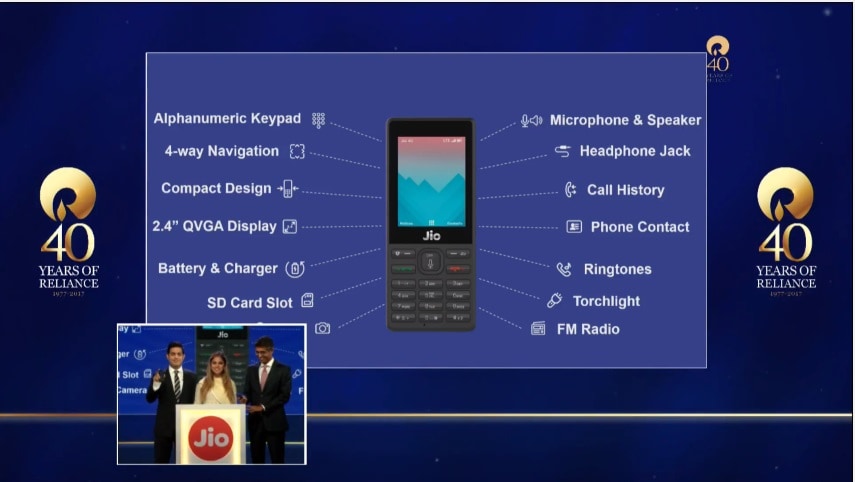
Yes, the Jio Phone's got all of the Jio apps - that means Jio Music, Jio Cinema and so on, and access to these is bundled with the prepaid plans for the phone, so even on a feature phone you'll be able to enjoy streaming services. It supports other apps as well, including Facebook, though WhatsApp is not supported at the moment. The phone also supports 22 Indian languages, and voice commands. You can send messages, place calls, search the Web, and so on, using voice commands.
Another interesting feature of the Jio Phone is NFC support - with this, users will be able to make payments from a linked bank account via UPI, or through POS machines in place of a debit card. This will be enabled later via a software update, although the hardware is already present. The mobile also comes with an integrated panic button.
ALSO SEEJio Phone Launch in Pictures
Jio Phone Specifications Features Launched Mukesh Ambani Jio Phone specs specificationsJio Phone features revealed at the Reliance AGM
The Jio Phone will also be able to mirror content from apps such as JioTV and JioCinema on TVs (including old CRT TVs) using a cable that the company has developed. Users will need to subscribe to the Rs. 309 Jio pack to avail this feature.
While company went in detail regarding the features, there was not as much focus on Jio Phone specifications. As a feature phone, the device has an alphanumeric keypad, and a small 2.4-inch colour screen. Apart from the presence of a rear camera, FM radio, Bluetooth, NFC, and of course 4G VoLTE, not much is confirmed at the moment.

SSC Recruitment 2017 – Apply Online for Stenographer Grade C & D Exam: Staff Selection Commission (SSC) has announced a notification to conduct Stenographer Grade C & D Examination 2017 for the recruitment of Stenographer vacancies. Eligible candidates may apply online from 17-06-2017 to 15-07-2017 up to 05:00 P.M. Other details like age limit, educational qualification, selection process, application fee & how to apply are given below…
SSC Vacancy Details:
Name of the Exam: Stenographer Grade C & D Examination 2017
Name of the Post: Stenographer
Age Limit: Candidates age should be 18-27 years as on 01-08-2017. Age relaxation is applicable as per rules.
Educational Qualification: Candidates should have passed 12th Standard or equivalent from a recognized Board or University.
Selection Process: Candidates will be selected based on computer based written exam & skill test in stenography.
Application Fee: Candidates should pay Rs. 100/- through SBI Challan/ SBI Net banking or through credit/ debit cards of any bank. No fee for Women, SC, ST, PWD and Ex Servicemen candidates.
How to Apply: Eligible candidates may apply online through the website www.ssconlie.nic.in from 17-06-2017 to 15-07-2017 up to 05:00 P.M.
Instructions to Apply Online:
1. Candidates log on the website www.ssconlie.nic.in
2. Click on Apply & Select the desired post
3. Again Click on Apply Link
4. Fill the form in 2 Parts (Part-I Registration, Part-II Registration).
5. In Part I Registration, Candidates have to fill basic information carefully.
6. After filling the Part-I, If there is no need to make any corrections then Click on “I agree” button. Thereafter no correction/ modification etc will be allowed.
7. Registration No will be generated, Note down the registration number or take out the print out of the page.
8. In Part II registration candidates have to enter the payment details, upload the photograph & scanned signature.
9. Those who are exempted from payment of fee can skip that entering those fields.
10. Fill all the details carefully & Submit the form.
11. Now take printout of online application for future use.
Important Dates:
Start Date to Apply Online17-06-2017
Last Date to Apply Online15-07-2017
Date for Payment of Fee18-07-2017
Date of Computer Based ExaminationFrom 04-09-2017 to 07-09-2017
For more details like reservation, exam center, syllabus, Permissible disability for PH candidates, relaxation details, scheme of examination & other information click on the link given below…
SSC Recruitment 2017More Information
Recruitment AdvtGet Details
Apply OnlineGet Details

SSC Recruitment 2017-1102 Scientific Assistant Posts

SSC Recruitment 2017-1102 Scientific Assistant Posts

SSC Recruitment 2017 – Apply Online for 1102 Scientific Assistant Posts: Staff Selection Commission (SSC) has advertised a notification for the recruitment of Scientific Assistant in India Meteorological Department, Group B, Non-Gazetted, Non-Ministerial vacancies on regular basis. Eligible candidates can apply online from 18-07-2017 to 04-08-2017 upto 05:00 p.m. Other details like age limit, educational qualification, selection process, application fee & how to apply are given below…
SSC Vacancy Details:
Total No. of Posts: 1102
Name of the Post: Scientific Assistant
Age Limit: Candidates age limit should be not exceeding 30 years as on 04-08-2017. Age relaxation is admisssible as per rules.
Educational Qualification: Candidates should possess Bachelor’s Degree in Science (with Physics as one of the subject)/ Computer Science/Information Technology/ Computer Applications or Diploma in Electronics and Telecommunication Engineering from a recognized Institution/ University or equivalent, have passed 10+2 Examination from a Recognized Board or equivalent in Science with Physics and Mathematics as core subjects.
Selection Process: Candidates will be selected based on applicants performance in computer based exam.
Application Fee: Applicants required to pay RS. 100/- through SBI challan/ SBI Net banking or through credit/ debit cards of any bank. All women candidates and candidates belonging to Scheduled Caste, Scheduled Tribe and Physically Handicapped categories are exempted from paying application fee.
How to Apply: Eligible candidates can apply online through the website www.ssconline.nic.in from 18-07-2017 to 04-08-2017 upto 05:00 p.m.
Instructions to Apply Online:
1. Applicants should log on the website www.ssconlie.nic.in
2. Click on Apply & Select the desired post
3. Again Click on Apply Link
4. Fill the form in 2 Parts (Part-I Registration, Part-II Registration).
5. In Part I Registration, Candidates have to fill basic information carefully.
6. After filling the Part-I, If there is no need to make any corrections then Click on “I agree” button. Thereafter no correction/ modification etc will be allowed.
7. Registration No will be generated, Note down the registration number or take out the print out of the page.
8. In Part II registration candidates have to enter the payment details, upload the photograph & scanned signature.
9. Those who are exempted from payment of fee can skip that entering those fields.
10. Fill all the details carefully & Submit the form.
11. Now take printout of online application for future use.


Important Dates:
Starting Date for Apply Online18-07-2017
Last Date to Apply Online04-08-2017 upto 05:00 p.m.
Date of Computer Based Exam (Paper I & II)20-11-2017 to 27-11-2017
Date for Generation of Challan04-08-2017 upto 05:00 p.m.
Last Date for Payment of Fee through Challan of SBI08-08-2017 upto 05:00 p.m.
For more details like salary, experience, exam details & other information click on the link given below…